
How to Talk About Grief Any Time, Any Place, and With Anyone!
- Hogan Hilling

- Jun 9
- 4 min read
In addition to talking about grief, it’s important to learn how to talk about grief. Primary grievers often talk about grief from a place of anger, sadness, frustration, vengeance, and resentment. Yes, it’s okay to feel these emotions. It’s part of the grieving process. However, it’s unacceptable when it becomes evil behavior that emotionally harms people and persists for long periods.
Most secondary grievers and even strangers will generally give a primary griever an open ear. But when a griever expresses negative emotions over time, it turns people off and discourages them from practicing the one thing a primary griever desires from others: empathy.
Another reason people stop talking to primary grievers is that they don’t want to set off triggers that cause primary grievers to cry, fall apart, and experience more emotional pain. In a small way, they are practicing empathy. They don’t want to hurt the primary griever. But all the avoidance does is exacerbate the grief.
Sometimes, another issue arises: what I call the “grief standoff.” People who haven’t lost a loved one have told me that they don’t know what to say or when to say it. Ultimately, they don’t say or do anything. It leaves the primary griever wondering why they aren’t receiving any phone calls or visits to check in on them and show empathy. This results in the primary griever getting upset and falling further into the grief abyss. But there is a way to escape. And that is by changing one’s mindset and attitude.
As Elie Tahari said, Whatever energy you put out there, that's the energy you're going to get back. The core idea is that the energy you radiate, such as kindness or negativity, is reflected back in your experiences and life. The energy you emit through your thoughts, feelings, and actions influences the experiences you attract and the people you bring into your life. It is a core principle in concepts like the law of attraction and a fundamental idea in personal development and motivation.
Body language can "turn on" or "turn off" people through a combination of physical and nonverbal cues that signal interest, openness, disinterest, or defensiveness. Crossing your arms, slouching, breaking eye contact, or looking away will turn people off and make them less likely to talk to you. Whereas an open posture, maintaining appropriate eye contact, smiling, and leaning in slightly will encourage people to embrace whatever you would like to share and spark further conversation.
When a primary griever speaks about grief from a place of peace, happiness, and grace, people tend to respond positively. They will also be more receptive to practicing empathy, offering support, and making time to check in.
Here is a personal story that demonstrates how to talk about grief in a way that makes people feel comfortable, even with strangers.
After Wesley passed away, when strangers asked me if I had children, I made the mistake of mentioning his death at the beginning of the conversation. Yes, I have three boys, Grant, Wesley, and Matthew. And Wesley passed away.
By sharing the news of Wesley’s death at the beginning of the conversation, after the person shared his or her condolences, the conversation was redirected or ended because the person felt uncomfortable talking about Wesley’s death and my grief. It made me realize I needed to change the way I talk about my grief and Wesley’s death.
The next time a stranger asked if I had children, I replied, I have three children: Grant, Wesley, and Matt. That’s it!
If someone would like more information, I’ll share it when they ask later in the conversation. This strategy encourages people to feel comfortable talking about grief. Delaying news of Wesley’s death gives the person time to get to know me. Eventually, the person will ask me for details about my children. That’s when I tell them Wesley passed away. This leads a person to ask more questions about Wesley, like how he died, his age, the nature of his disability, his personality, and what he was like.
Here is an example of a conversation I had with a married couple, Mike and Katie, whom I met at a bar in a restaurant in Minneapolis, Minnesota. Mike, Katie, and I spent the first hour getting to know each other. They were high school sweethearts. Mike is a successful businessman in the fiber-optics industry, and Katie is a top-performing employee at Best Buy. Together, they have done well financially. Both support each other’s work and hobbies.

One of Katie’s hobbies is playing Texas Hold’em poker tournaments. She told me she will be playing in her first World Series of Poker Main Event from July 2nd to July 16 at the Horseshoe and Paris in Las Vegas. Mike joked that they could either pay $10,000 for a new driveway or for Katie’s entry fee at the World Series of Poker Main Event.
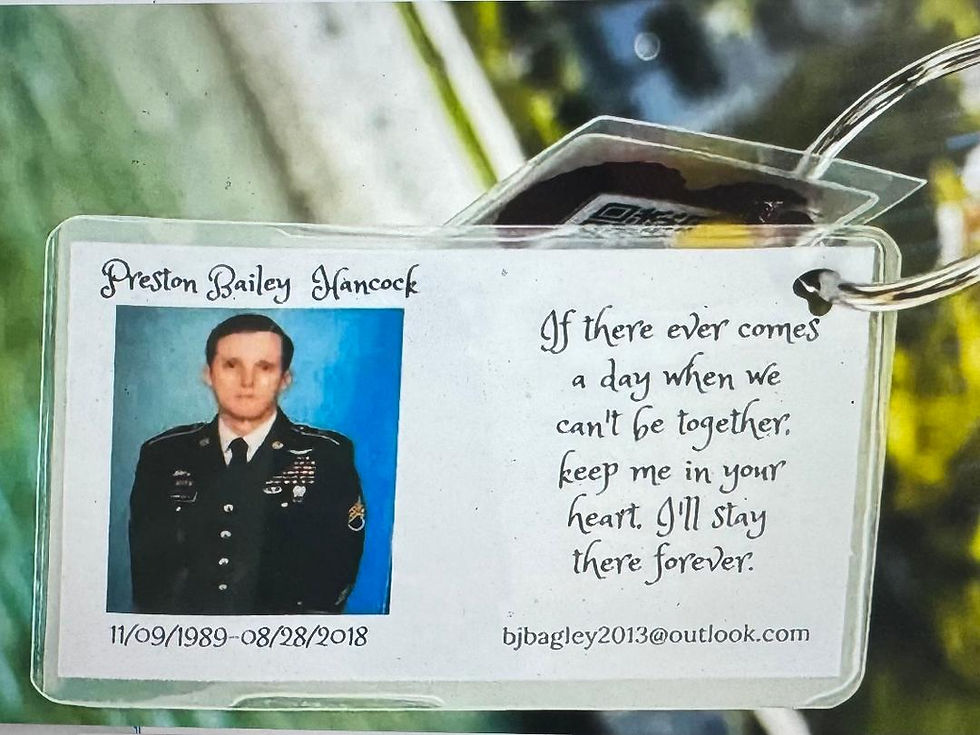
Eventually, Katie asked me about Wesley’s Charm, which was hanging around my neck. What is that hanging around your neck?
After I told Mike and Katie about Wesley’s death, they both stood up out of their barstools and hugged me. I briefly told them the story about leaving one of Wesley’s Charms in every state. Then offered one and handed it to Katie, who said, I know what I’m going to do with Wesley’s Charm. I will take him to Vegas and the Poker Tournament with me!

One month later, Katie sent me a photo of Wesley’s Charm in Las Vegas and of her playing at the poker table. Lady Luck was not on Katie's side. She only made it to the second day.

I realize it’s hard to change one’s mindset. But ask yourself this question. Is the way I’m behaving encouraging people to practice empathy with me? If it isn’t, then it’s time to learn a new way to talk about and express your grief.
I hope my story with Katie and Mike will give you the confidence and courage to feel comfortable talking about grief anytime, anyplace, and with anyone, even strangers, in a way that encourages empathy from people!
Together, Let’s Break the Silence and Heal With Peace, Grace, and Harmony!


Comments